Showing posts with label Leagues. Show all posts

Wednesday, 24 January 2018

The Winter Football issue - is Futsal the answer?

It's a common issue every year for grassroots football across the country.

A downpour of rain over night and your weekend can be ruined in one moment when you receive the dreaded message.

'Game is off'.

It is a constant point of debate amongst supporters of grassroots football. What can be done to stop this annual period of postponed games due to waterlogged pitches and bad weather?

Some of this discussion turns to the state of facilities for the grassroots game. 3G pitches were recognised as the way forward, with the core issue being funding. While the Parklife scheme is being
rolled out across the country by Sport England and the FA, a lack of facilities at this current time has been considered a real issue. And hearing the prices that some of these football 'hubs' are going to charge to hire it anyway, I'm not sure it's going to solve much of the problem.

Just this weekend, a central venue league for under sevens which play all their games on a 3G astro had to call off their games anyway. We can have as many astro turf pitches as we want but if even they get ruined by the weather, we need another plan.

A familiar sight
Another idea has been to move the grassroots football season to the summer. Whilst this is a decent proposal there will be issues around holidays, the great summer tournaments we have in that time and importantly, sports such as cricket would really lose out. 

More recent talk has centred around an alternative solution. Leagues have begun to pilot winter Futsal programmes.

This just seems to make so much more sense than the current, traditional set up. There are plenty of halls, such as in primary and secondary schools, with the space to play games in. The facilities would not be hard to come by with the right planning and are probably cheaper too. Futsal goals may be an issue, but again with the right preparation this can be organised in good time. It could be as simple as running through the start of December to the end of January, the times were traditionally rain stops play. 

This is not an attempt to stop kids playing in the rain, as some might worry or claim the world is going mad. I love football in the rain, but it is this period where games are routinely called off due to the pitches being unplayable that we need to find a solution for. Additionally, the pitches that regularly take a hammering could get a much needed rest as well and be in better condition potentially by the time the football season starts up again.

From a player development perspective, this could be massively beneficial too. Whilst Futsal is a sport in its own right, there is no denying it could be a great tool for improving a player's technical ability, especially in the early ages. That combined with decision making, with less space and time on the court, can add to the holistic development of a player. 

We wouldn't quite need these facilities...
It could be viewed from a multi-sport perspective too, with a variety of health and social benefits. This would offer something alternative, something fresher, to also give young players a chance to try something new that actually they may want to take up later down the line to stay physically active.

There would, I am sure, be other minor barriers. Such as knowledge of the rules of Futsal for players, coaches and importantly, referees. Or having to buy enough Futsal specific balls for the games.

Once again, these are problems that are simple enough to solve and while it may take some more of our time (and money) it may just be worth it. 

Saturday, 8 April 2017

You are the ref: what next?

I have always had very strict principles when coaching my players about how they 'communicate' with the referee. This is someone who is giving up their time in order to help them have an organised game of football. Dissent will not be tolerated. 

Although it is slightly different in the professional game, as the art of refereeing becomes professionalised too, I still believe in similar principles. Even if you feel a referee performs, in your view, 'badly' they should not be used as a scapegoat for your team's failure to win a football match. 

If you google 'Mourinho referee' there are
loads of pictures  just like this one.
These are people who in comparison to the players and even managers, make far fewer mistakes. The issue they have, not too different to the role of the goalkeeper within a football team, is that if they make a key mistake it is magnified.

The referee's performance provides an easy excuse for under pressure managers (looking at you, Jose) or a way to deflect from a poor team performance (and again, Jose). 

Being a Wolves fan, much has been made of the standard of officiating in the Championship and it was difficult not to be bemused at the events that occurred this week in the Newcastle -Burton game

Keith Stroud's decision to give a free kick for encroachment at a penalty was one of the strangest decisions I have seen for a good while. Understandably, due to the pressures that come at this level; fans, players and managers were in uproar. 

The easy and standard thing to do here is to make a generalisation about how poor referees in the football league are, and that we have a problem with their knowledge of the game. However, I see more of a cultural issue that is deeper rooted. 

Retrospective punishment provides a simple example of this. When a referee does not spot something contentious in the game, it can go one of two ways. If he admits he did not see it and that is why he did not take action, retrospective punishment can be enforced. That is fine. But when the referee claims he did see it the powers above will do nothing. In principle, I can understand this, they don't want to over-rule the official or look as if they are throwing them under the bus. 

What I feel this does however, is make the situation worse. What they are allowing the referees to do is not admit to mistakes. Having recently read Matthew Syed's Blackbox Thinking (highly recommended) this is an example of a 'closed loop'. This is a fixed mentality where failure does not lead to progress. If the referees feel as if they can not admit to mistakes (usually as they know they will be given a weekend off or be demoted to a lower division) then progress will be stunted. 
We may not be seeing Mr. Stroud for a few weeks

If mistakes are not identified as learning opportunities, how can we expect the standards of refereeing to improve? This is a key issue that I feel that the PGMOL (Professional Game Match Official's Limited) and the Football Association have. Within their inner circles, it may well be that referees have mentors that help them following mistakes, but the way it is dealt with publicly does not give this image at all.  

The scenes from the game also do not point to this type of environment. If there was an acceptance of mistakes, surely his assistants or the fourth official would have interjected and the farce that ensued would have been stopped in its tracks? It is likely that they were too worried to undermine the man in the middle. 

When I first saw that Howard Webb was a part of the BT Sports team of pundits, providing an insight on referees during the game, I wasn't sure if I liked it. As mentioned earlier, it might seem as if he is throwing his former peers under the bus. In the long run, it could help. He is not lambasting referees for making mistakes, just making observations on what decision they could have alternatively done.

Hopefully organisations can follow suit and we will see more progress. Otherwise, we will continue to see the same mistakes made over and over again. And isn't that what Einstein said was a sign of insanity?

Tuesday, 27 October 2015

Central venue leagues: the way forward for grassroots football?

Starting up a grassroots football club is difficult (and then running it is pretty tough too!). There are so many considerations to take into account such as; insurance, affiliation, attracting players and finding volunteers amongst many.

Another challenge is finding a suitable home venue. One where a club can provide a pitch for all it's teams if required on one day. In the modern day it is rather difficult to find that kind of space and furthermore, if such a place exists it is unlikely that one club can have access to all the pitches just for themselves.

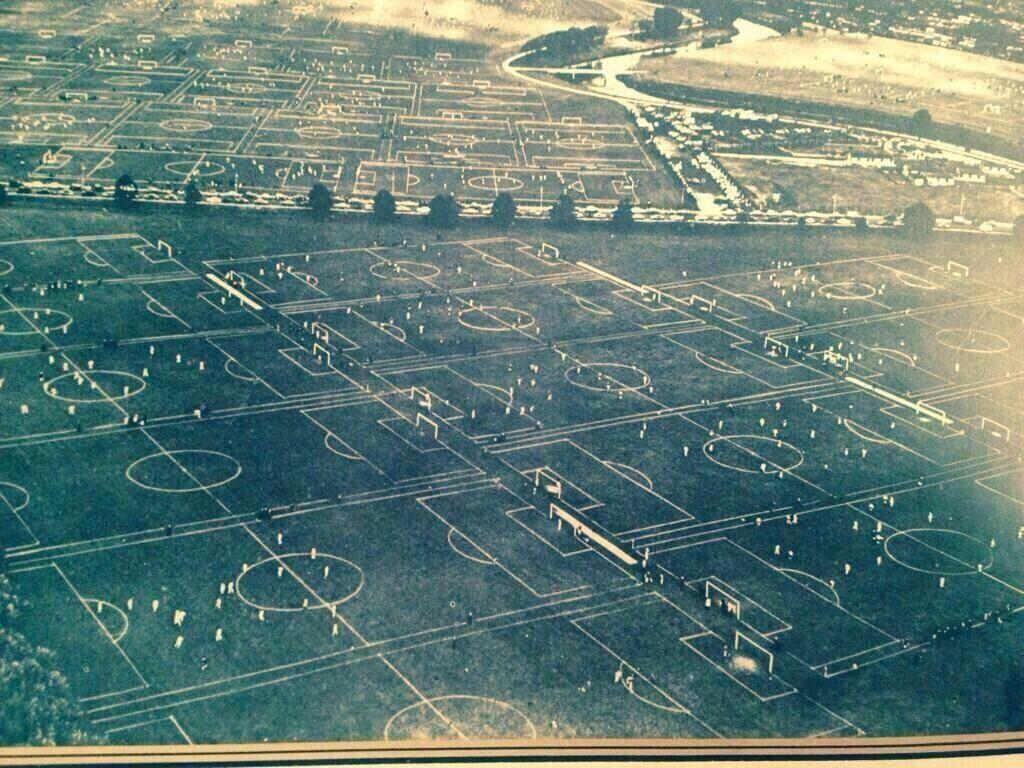
Hackney Marshes was - and still is - a great venue for football
So when the grassroots club that I work with in London looked to address this problem, a league in East London provided the solution. All games in this league were held at one venue with the pitch and referee part of the package.

For clubs who struggle with the logistics of arranging home and away matches at the weekend, this eradicates that issue completely. And for those who do not have a coach per age group, it allows them to travel from game to game with relative ease.

This year I have been coaching with an under sevens side in the Southampton area. The league they are in have a similar system but play the games on an astro turf pitch. They are able to run three games simultaneously, with each game filling roughly an hour slot. This runs most of the day on the Sunday so it allows plenty of teams to play football on a quality surface where games are also significantly less likely to be called off. And what's more, there is a great atmosphere about the place (below is a picture of the first thing you see when you arrive).

A great sign to see entering the pitches
in a youth league in Southampton
If this became a more common system across the country it could become a real positive for scouts and people working in talent identification. I mentioned in a previous blog that scouts appear more prominently at summer tournaments and I would imagine this is because they have access to more players in one place, saving them valuable time and money.  At central venue leagues this would be of a similar advantage for them to witness young players in a competitive, realistic environment during the season.

With the Football Association planning to create one hundred additional astro turf pitches over the next four years, when organisations and football clubs look to secure funding for these pitches a case for their proposal could be to have a grassroots youth league playing their on the weekend. This would provide evidence for it being financially sustainable, in addition to the potential stream of money that would come from the hundreds of people that will be there who may want to buy tea, coffee, hot food etc.

I hope that this can become a more common sight. I have seen so many stories of clubs having to fold and this could be one mechanism that can help to reduce that occuring so often. There is a real possibility I believe for creating a system that can be easily organised nation wide which would begin to improve and bring together the grassroots football community!