Friday, 20 July 2018

What did we learn about England?

It is fair to say that England national team's performance at the World Cup went way beyond what most of the public expected of them before the tournament began. 

A first semi final for our men's senior side in twenty eight years, coming so close to a first final since 1966 (if you didn't know, we won it that year), capped off a tournament that can only be reflected on positively. 

Now the dust has begun to settle after a small heartbreak and a defeat in the third place play off, I thought now was an opportune time to reflect on what we have learned about this side, the manager and the wider implications this will have for the future of English football. 

The 'England DNA' bearing fruit 

Over the past two years I have made videos to highlight the impact of the England DNA on our national teams. It was becoming more and more evident that there is a visible difference in the way that England teams approach tournaments and more broadly, the way they play the game. 

England's senior women side have also made great strides
We had unprecedented success last summer with the Women's senior side reaching the European Championship semi finals, the U20, U19 and U17 sides winning major tournaments and the U21s themselves reaching a semi final. This was as clear a message as can be that England can have high aspirations for the future, with the level of player coming through the ranks and the cohesion of the sides. 

This tournament could be identified as an important acid test to understand whether the new approach could truly take England beyond what we have come to expect. At previous tournaments expectations have been built up and crushed with dull, drab and sometimes disastrous performances. Eight years ago we were given a serious reality check when a young Germany side swept us aside when we had been one of the pre-tournament favourites (Capello's self-destruction in that six month period is possibly a blog for another time). 

This tournament was different though. Gareth Southgate had slowly phased out some of the higher profile (Rooney, Hart - even Cahill consigned to being just a squad member) and not like Steve McClaren did with David Beckham only to go crawling back to him in a time of desperate need.

We attacked the tournament with a youthful side, full of character and energy. We try to play games on the front foot even if we did fall short against some of the better teams and individuals we found ourselves against. But it wasn't half refreshing to see an England team perform above expectations and more importantly, like a TEAM. It is not that lack ago that we had world class footballers who for whatever reason (there are many) they just could not function effectively together. 

Staying on trend

As is stated in the England DNA: "England teams will play with tactical flexibility, based on the profile of the players available and the requirements of the match or competition". Southgate made his intentions to play with three central defenders clear as soon as qualification finished. It was later revealed he and Steve Holland (assistant) decided this was to be the way forward for the team at the World Cup having been to watch the Confederations Cup. 

Playing with three central defenders is becoming a more common theme in modern football again so while this was hardly an act of genius by the coaching team, it was necessary when it would have been easy to stick to the tried and trusted four at the back. Not only did having an extra central defender help us to look more solid out of possession, it also improved our build up play out from the goalkeeper, something we have struggled with in the past. Having a central player with the quality and bravery of John Stones on the ball obviously helps, but this was a wise move. 

This ability to recognise the current trends and use it to our advantage I think showed a flexibility that we had not seen from an England senior team before. We have often lagged far behind when these trends move on, as they tend to do but this time we were largely on the right side of this. 

What was also interesting was our shape in midfield, making it a 1-3-5-2. Again Southgate made clear the intentions pre-tournament to play with a single holding midfielder with two more attack-minded midfielders outside of that player. In fact after the first friendly against Nigeria, Southgate described those outside midfielders and the two forwards as a 'front four'. This was a brave move, but it suited our players and we saw our team attack with pace and freedom. 

It is easy to say this in hindsight but I do wonder whether there was ever a back up plan of a 1-3-4-3, with two defensive midfielders and supporting forwards for a lone striker. Against Croatia in particular when we lost the control and momentum in the game I do feel we could have brought Dier on alongside Henderson (before he was forced off with injury later on of course) to give us more security. 

This would also have given us more balance defensively and potentially more options in the transition from defence to attack, as we ended up conceding possession quite easily. More flexibility in game could have been required as per the DNA. However, I would argue this is me being picky and that fact we can have these discussions about a World Cup semi final performance is still a huge positive.

Meticulous Southgate

“We had talked long and hard about owning the process of a shootout."

Watching England win a penalty shoot out was an incredible moment I will treasure for a long time! In the aftermath, what seemed a miracle quickly became clear that it was very much a victory for appropriate planning! From practising in training to the water bottle with writing on it handed to Jordan Pickford, this was an example of the level of detail that went into this tournament by Gareth Southgate and the England staff.
Will we continue to see the waistcoat?

During the tournament, I read an article about how players were now fist-bumping instead of doing hand-shakes to help prevent illness!

I enjoyed this analysis of the Harry Maguire goal against Sweden, in the quarter finals. Much has been made of the Alan Russell's influence on set pieces already and the praise is fair. In a tournament where set pieces were key to team's successes England were able to take advantage of this. 

Previously England have relied on high quality players to swing the ball in and we have hoped for the best. David Beckham, Steven Gerrard, Frank Lampard etc all had wonderful delivery but often we didn't take advantage of this. In this tournament, nothing was left to chance. Arguably though, we became too reliant on set pieces!

Restoring a relationship

I have already alluded to the general low expectations of the fans and media but something that had also set in over the past few years was apathy.

I was there for Southgate's first game in charge of England. A pretty drab 2-0 win over Malta, goals from Daniel Sturridge and Dele Alli in the first half. It was a pretty painful watch (Wayne Rooney being outrun by a Malta midfielder was a particular low point) - but what was most clear was a lack of atmosphere and enthusiasm amongst the crowd. 

What will now be most interesting is how the fans treat the upcoming fixtures. The first game since the World Cup is a UEFA Nations League tie against Spain and this will be the first opportunity for England fans to show their support and excitement after a positive tournament. It can inspire people across the country.

We have players not only now with experience at the top level now but also characters that fans can seemingly embrace and relate to. We have a team from a wide range of backgrounds and it has been great to see Southgate embrace this and point to the strength that a diverse England team can bring. This article by Musa Okwonga gives a great perspective on the benefits England's performance can bring away from the pitch.

Southgate the man to take England forward? 

Pre-tournament, Martin  Glenn claimed that even if we struggled in the group stages of the World Cup that Gareth Southgate's job was safe. Fact is, had we failed to get out of the group he would surely have resigned, or been under pressure to anyway. 

We did not struggle though, winning the first two group games for certainly the first time in my lifetime and having the opportunity to rest players in the third game. 

Southgate was given a four year contract, seeing him past Euro 2020 which is now unimaginable that he will not lead us into that tournament, in which seven of the games are at Wembley. The "it's coming home" bandwagon is most certainly less than two years away.

Whether it is through the UEFA nations league or qualifying, expectations will be a lot higher to deliver qualification in style. We bored our way to qualification for the most part for this World Cup, playing two defensive midfielders (Jake Livermore one of those) in a 1-4-2-3-1 and squeezing our way past smaller opposition. With a rising interest in the national team that won't be taken as lightly as it was previously, when expectations were lower. 

However, I think there is an intrigue into how the manager can take us forward having made great strides in such a short amount of time. He certainly deserves that chance at least. 

The Future is Bright - if there is opportunity 

There is certainly reason to be optimistic when you know that Pickford, Stones, Trippier, Alli, Lingard, Sterling, Kane, Loftus-Cheek, Rashford have all got several tournaments left in them. The slightly older players at this tournament are probably the ones which were identified as areas we needed strengthening in. 

Jordan Henderson performed admirably but where is the playmaker who can control games and take us to the next level coming from?

Our young players have excelled in youth international
tournaments in the past two years
Ashley Young played beyond my expectations but we really lacked a balance on the left side (no outfield left footed players in the first eleven). 

Kyle Walker did extremely well in an unusual position for him but we still require another defender with the quality of John Stones to push us forwards. 

Fortunately, we have an unprecedented level of talent coming through the system. The English academy system is producing some of the best talent in Europe, maybe the world. 

Phil Foden, Jadon Sancho, Ryan Sessegnon, Mason Mount, Callum Hudson-Odoi, Trevor Chalobah, Rhian Brewster and Jonathan Panzo just to name a few. There are more, many more but the key issue now is the next stage of their development once they come through their respective academies. 

Players have to be given the opportunity to develop, the higher the level the better. Hence why we have seen players begin to leave England early seeking opportunities, mainly in the Bundesliga. The German clubs are recognising the level of player English teams are producing. 

Hopefully, the English clubs will begin to realise this too! 

I'd be very interested to know your thoughts on what is required for England to take the next steps and be a force to be reckoned with consistently! 

Thursday, 31 May 2018

"Every player has their own talent": Inside Vitesse Arnhem

Between 17-19 May, I attended a coach education tour of Vitesse Arnhem's youth academy. This was run by Murray Jones of Football Tours and Events, which you can find out more about here. The below blog is my summary of the three days...

Vitesse Arnhem are (proudly) one of the oldest existing clubs in Holland. Founded in 1892, the club celebrated their 125th year of existence by winning their first ever trophy. Last May they beat AZ Alkmaar to lift the Dutch cup, goals from Ricky van Wolfswinkel (remember him) sealing a two nil victory.

Vitesse have more recently been in the spotlight for their 'close working relationship' with Chelsea, as their owner Alexander Chigirinsky is close friends with Roman Abramovich. Whilst this has helped bring in young talents, the owner has also placed a close emphasis on the youth academy with a budget on a comparable level to category one clubs in England.

Over the three days were fortunate to have a great level of access not only to their facilities, training sessions and games but important staff members such as Bart van Rooijen and Richard van Der Lee (both co-ordinators within the academy). As a club, they are very proud that they are one of five clubs awarded 'International Certification' by the KNVB (Dutch Football Association). The other four clubs being Ajax, PSV, Feyenoord and AZ Alkmaar, so they are in good company!

Facilities

View of the 1st team training pitches
The Papendal Olympic training centre lays home to Vitesse's academy and senior training ground. Whereas when I visited Ajax's de Toekomst everything was very close together, Papendal is a very open and scenic place. It's very pleasant to walk around and has a very relaxing nature. There are many pitches, some specific to the first team (with positional play lines much like Ajax had) and also an astro pitch in front of the shiny newly built main building, financed by the owner. Every age group through to the senior side can be seen walking through the building, which generates for a great environment in which the young players know the senior players well. Mason Mount, loan star from Chelsea, is one player who was highlighted and praised for their interaction with the academy players.

Gelredome (minus pitch)
The Gelredrome stadium, leased by Vitesse as they no longer own due to previous financial difficulties, holds a capacity 34,000 people. This is more than enough space for a club like Vitesse, whose fan base is much smaller and average gates of around 14,000 fans. It is a very interesting ground however. On arrival, t is instantly clear that it is not owned by Vitesse, with as many pictures of popstars on walls as there are footballers! The ground is particularly interesting for two reasons, it's retractable roof and convertible pitch. When we had a stadium tour the roof was on and the pitch was retracted (see picture), which made it feel very un-football like! As the roof is so heavy, the corners are filled by concrete which you could imagine takes away from the atmosphere.

Vision

The youth academy's vision places an importance on the individual player. Developing the individual to make the most of their talent is number one on the agenda. However, they can not develop or win alone, meaning players must learn to work together and work as a team. This will also enable them to learn to play in the framework that Vitesse set for the coaches to teach the players.

"Players will make their debut in the first team, not the team!"

Essentially, it is more about the individual than about the team. As they move through the age groups, it is still about the needs of the individual player. Although the teams play in competitive leagues, if a player needs to be challenge further, they will move them up a team even if that could negatively affect results (for either side). A good example of this was a fixture we watched between Vitesse and PSV, who had won the league already, at  under 15s level. Vitesse needed just a point to finish in the top three of the top division, but had several under 14s players in the side. The game was still competitive, both teams really going for the win and ultimately PSV won 2-1, but their players would have learnt a lot against a good side.

The main target of the academy is that the first team squad will be filled by 40% of players trained by the academy. Furthermore, 50% of those players will make up the starting eleven. As it stands they have many players in the squad, but not the starting eleven, hence the second of those targets. These targets are set not just because they want to develop talent but also so that they can sell talent. The club often lose players to Ajax, PSV etc at youth level but if they can hold onto their best talents until senior level they will bring in more money when they sell them. So in part, much like Ajax openly admitted when I visited them, it is a business model.

Interestingly, they cite the connection with Chelsea as a means to help their young players. If a young player with potential is not ready yet for a first team place, rather than sign a player (on a multiple year contract) they can loan a player for a season. That way, the academy product has another year to develop which they can evaluate without a player blocking their path come the next season. This was an angle I had not previously considered!

At the core of their vision is developing a passion for the game. The players who make it through the age groups will be the one that have the most passion and love for football. For that reason they aim to make football a fun game to play (again, parallels with Ajax's ideals). In addition to this, they can then develop creative players, who play with initiative. "Every player has their own talent".  

The Vitesse academy look for several qualities in the profile of a player; Proactive, Quick learning, Athletic skills, Winner's mentality, Technical ability and, last but not least, their own character. The club look for potential and not necessarily performance. To them, it would be very easy to look at current performance but they feel it is important to take the tougher route and attempt to find players who with time will grow into better players, using the qualities mentioned. Furthermore, as people they are looking for curious individuals, who are respectful and again, have their own character.

In terms of Talent ID, Vitesse work with ten grassroots clubs in the region. These partnerships are not financial but the clubs they work with get benefits such as coach education and tickets to games. The obvious benefits for Vitesse themselves is the opportunity to build a network to help them identify potential talent. This is something I feel is sorely lacking in the English game. It is something that would come at minimal cost to clubs but create a network of people to help find the right players for a club. Equally, it can strengthen the grassroots game with coach education to help make the level of player coming through stronger.  Looking more broadly, across the county, Vitesse have 20 national scouts. This gives them the opportunity to recruit in areas such as Amsterdam and Rotterdam where there may be missed talents in more densely population regions.

"Are you ready for the game of the future?"

At Vitesse, they stress that football is always changing. To stay ahead of the game, they must keep thinking forwards and being innovative. In order to keep progressing, they must keep adapting and looking at others and themselves. 

Vitesse want to "play dominant, attractive and dynamic football with players who can translate this in all circumstances in practice"

We had many excellent presentations in the media room!
They do however have guiding principles for how they want to develop players and the style in which they want to play for. They start off simple eat the younger ages with less topics/areas but as they get older they are exposed to more detail and depth around the Vitesse way of playing. These fall under, very simply; Defending, Attacking, Transition from Defending to Attacking and Transition from Attacking to Defending. 

We were fortunate to have a presentation from the U19s head coach, Ben van Dael. Ben had a wealth of experience, working at VV Venlo for 15 years (spending time as assistant coach of the first team and also as the interim head coach) and had also been manager at Fortuna Sittard just a couple of years ago. He gave us a great presentation after a training session about what they had worked on and it's relevance to their upcoming game (which had unfortunately been cancelled). One thing he said that really stood out to me however was "it's not all about systems, it's about spaces". Vitesse play with a 1-4-3-3 formation, but that in itself is very flexible to meet the needs of the individuals and the demands of the game. 

Freedom and fight

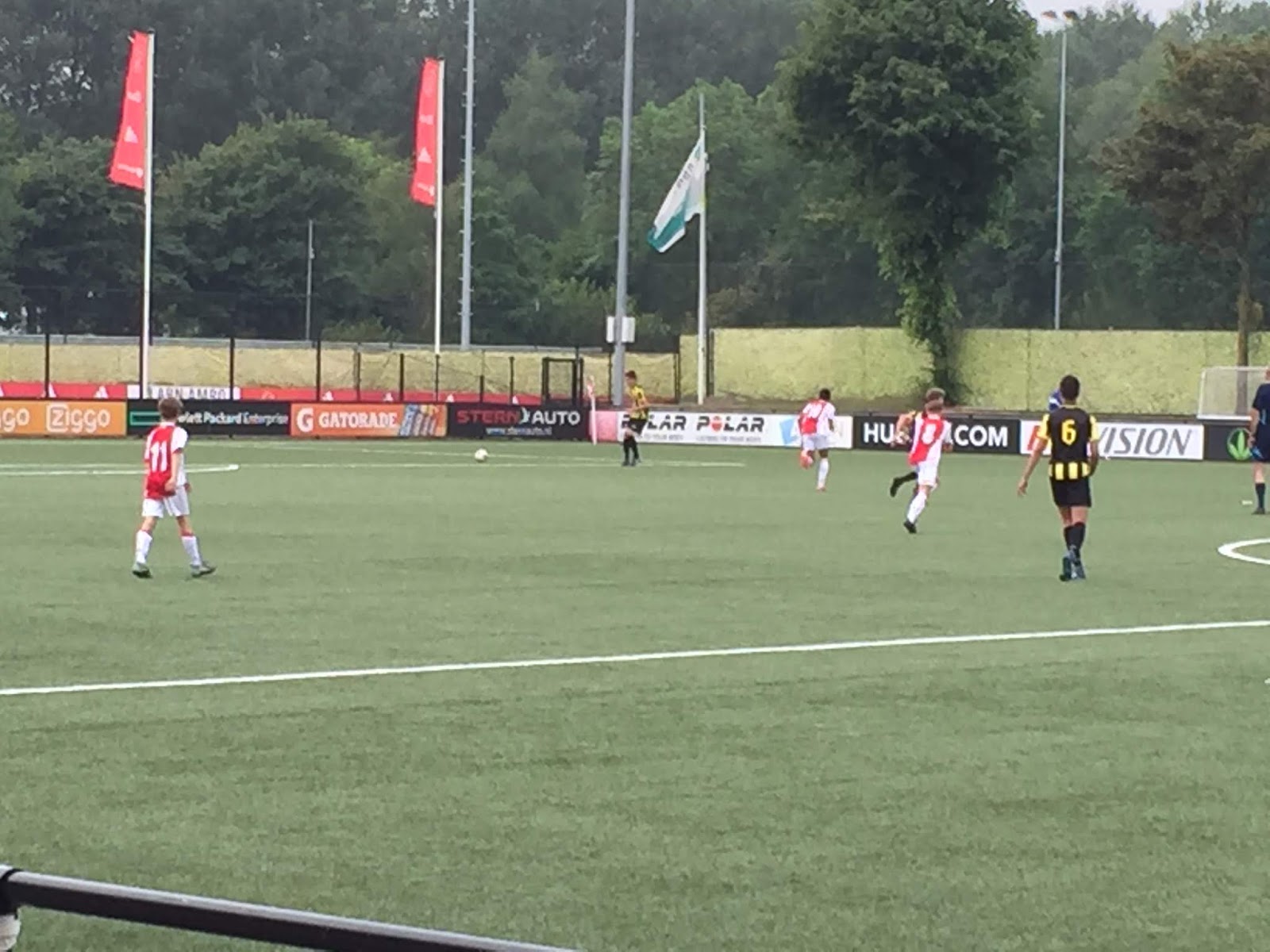
Ajax U14 v Vitesse U14
As we witnessed training sessions across the age groups there were many different types of sessions, covering different topics under those four areas stated. What was apparent to us, which Bart (van Rooijen) confirmed to us, is that the coaches have freedom to decide what they coach the group during the course of the season. This "lack of structure", if you can call it that, was a point of discussion amongst many attending alongside myself. Their thinking is that the coaches know the players the best. They are the ones that see them in training, and especially see how they play in fixtures in a competitive environment. The coaches just need to make sure that over the course of the year they cover the guiding 'principles' for that relevant age group. There is not a syllabus, so to speak, which is what those I attended with (including myself) are used to. 

Another similarity that lies with Ajax is that the coaches are there to 'help' and allow the players to do a lot for themselves. Each player has a talent and Vitesse are looking for the coaches to connect with the players, be positive and not get too emotional about mistakes - as it is important to remember the players are children. When players are struggling, they want to develop a player's character to 'fight' and keep going. This is evident when we witnessed Vitesse U14s v Ajax U14s, a fitting conclusion to the tour. Both sides showed a lot of talent, but despite having very little to play for (in terms of the league table) Vitesse's battling spirit prevailed, winning the game two nil. This gave a really clear image of what Vitesse Arnhem were about. They try to play football in an attractive manner, using a positional game but equally they display a hunger and desire to win the game. The players understand what it means to play for the club.

The three days or so that I spent there most certainly weren't enough, and I would love to visit again and learn more about how they implement their vision and principles of play into the teams and players across the age groups. I look forward to seeing how Vitesse, a club certainly on the rise, continue to develop their players and how they continue to utilise the relationship they have with Chelsea!

If you have any questions, feel free to ask in the comment section below. Thanks again to Murray Jones, who organised the whole trip and a top person too! 

Monday, 7 May 2018

Michael Carrick - a wasted talent?

Hearing that Michael Carrick would be retiring at the end of this season and taking up a coaching role at Manchester United was a sad moment for me.

Not just because he was a player who I often tried to model my own game on as a youngster, but because it made me reflect on an ultimately wasted talent.

Not necessarily at club level, where Sir Alex Ferguson saw beyond the criticism he had in his early days, when the pressure was on to find a replacement for Roy Keane. Ferguson recognised the qualities Carrick brought and had shown as a young player at West Ham and Tottenham. Carrick won pretty much everything there is to win at club level. 

It was on the international stage where he was sorely underused - particularly in the big tournaments. Carrick earned 34 caps in total. Nothing to be ashamed of, of course, but when you see that the likes of James Milner, Stewart Downing, Jordan Henderson, Phil Neville, Gareth Barry and others have earned more caps it irks me slightly.


Carrick in his prime is the player that England sorely need now and in hindsight, clearly needed during the era of the 'golden generation'. 

I suppose it seems strange that I might say that when England had midfielders such as Steven Gerrard, Frank Lampard and Paul Scholes (all regularly compared against each other). Sure, there was talent in the centre of park, where you could also consider David Beckham could play but what England really lacked was someone that could control the tempo of a game and be unnerved under pressure.

It was often question whether Gerrard and Lampard could, or should, play together in midfield. The evidence from their performances together in an England shirt suggests no but I wonder how they would have fared with a holding midfielder in Carrick behind them? 

England managers at one staged, particularly Sven, seemed wedded to 4-4-2 which meant shoehorning a player like Paul Scholes in at left midfield, or giving Gerrard or Lampard defensive responsibilities in the midfield unit. It was only when Michael Owen got injured at the World cup, and the other alternatives were Peter Crouch and Theo Walcott, did Sven decide to switch to a 4-5-1. 

Carrick was pretty unfortunate in this case too. Having performed excellently in his first and last game in an international tournament, he was dropped for Owen Hargreaves (who himself was playing very well, to be fair). Just when it seemed it had fallen into place it was snatched away from him. Here is a video where he is highlighted by pundits as man of the match in the game against Ecuador. 


Gary Lineker asks at the end of the video 'why has it taken so long for him to get a chance' and yet that was the last we would see of Michael Carrick at an international tournament! 

From 2006 onwards for several years, Carrick was one of the most consistent, high performing midfielders in Europe, let alone of the English players. It beggars belief as to how he was so vastly underrated by English managers.

Going into the 2010 World Cup, some of the concern was whether Gareth Barry would be fit in time, regarded as a key player. Fabio Capello response to Barry's lack of fitness was to change his whole game plan, ending up Lampard and Gerrard in a 4-4-2, once again. Carrick, meanwhile, spent the whole tournament on the bench. He was 28, at the peak of his powers you would argue! 

Roy Hodgson also appeared to neglect him, although he did make it clear that by then Carrick had made it clear he no longer wanted to join up with the squad only to be overlooked again. 

Looking at the current England squad; we don't really have an outstanding midfielder in that mould. Eric Dier is a good footballer, who can fill in at centre back or centre midfielder but I would not consider him to have the passing ability to play as a holding midfielder on his own. He benefits from having Mousa Dembele or Christian Eriksen around him where he can distribute the ball to them. England lack a player with the level of passing ability Carrick possessed, and that is a real issue considering the way the FA want England team's to try and play in this day and age.

My other concern is where the next 'Carrick' is going to come from? Do we place emphasis on this type of player in England? 

Don't get me wrong - the academies in England are clearly producing some seriously talented footballers. Whether they get the opportunity is another question of course, but the success of the England youth teams last summer points to a high standard coming through. But what I am hoping we can produce in the near future are players who can control the tempo of a game from deeper positions, players who can play under pressure to create space for other players. 

We have a lot of talented attacking footballers, and have many young players (Sterling, Kane, Rashford, Alli) in the current England squad but what we are really waiting for is a midfielder with the reading of the game, the vision and the composure Carrick demonstrated at his peak for Manchester United. 

It is nice to see that he is taking his first steps into coaching. If done in the right way, taking the necessary steps, he could provide a great insight for young footballers. He had a brain like few other English players and it will be very interesting to see the impact he may have at United next season. 

That said, I still can't help but feel that despite the success he had in his club career, he was a truly wasted talent in an England shirt. 

Sunday, 11 March 2018

Academy restructuring - set to become the norm?


"The Club has been forced to rethink the way it develops young players as a consequence of the impact of the Elite Player Performance Plan (EPPP) system."
This was the line from Tranmere Rovers FC following the unfortunate news that the club were set to, essentially, close down their youth academy. 

Tranmere have been in the Conference now for a couple of seasons. With a full time academy (and various other ventures that they are leading the way in), this was eventually going to be an area that they had to scale down should they not get back into the football league in the near future. 

This will have been tough on the many players in their academy that may not be so lucky to find another professional club. Tranmere have acknowledged themselves that and will try to assist them in finding new clubs but not all will be able to. Equally, I imagine many will have lost jobs and roles and have to find themselves new environments to work and coach in. 

However, Tranmere are not the first side to come to this conclusion following the impacts of EPPP. Wycombe, Brentford and more recently Huddersfield have all restructured in some form. 
Jason Koumas - a success story of
 Tranmere's academy in the past
All four of those clubs have produced a good standard of player from their academies. In days gone by, Tranmere have profited from the sales of Jason Koumas (£2.5m), Ryan Taylor (£750k), Ian Nolan (£2m), Clint Hill (£250k) who they had produced in their academy set ups which will have surely helped with the running of the club, let alone the academy. Due to the current system, Tranmere are now losing players for free at the younger age groups where they may previously have been able to hold onto players. 

These are not decisions that clubs are taking lightly. 

Brentford were well regarded in the competitive environment that is the London academy scene, with Miguel Rios, Kevin O'Connor and Ose Aibangee known figures for their good work at the club who were thriving in the Championship. 

Huddersfield cited their frustration at the lack of local players coming through to their first team. A startling fact in the BT 'No Hunger in Paradise' documentary revealed that Manchester City had more scouts in Huddersfield than Huddersfield themselves. They clearly did not feel the academy was value for money, despite having one U15 that was in the England youth squads and has since signed for Manchester United.  
"Running our academy in its current format (U8s to U18s) costs in excess of £300,000 a season and over the last two years we have lost over £500,000 of central funding for academy operations. 
  
Prior to the introduction of the EPPP system, the income from player sales offset some or all of the cost, and Tranmere had some notable success in developing and selling players." 
Tranmere's academy operated in, like Brentford, Wycombe and Huddersfield, a very competitive environment. They are probably used to losing out on players, but also probably made some good money previously for players that they lost to clubs around them. With EPPP making it easier for clubs in the higher categories to sign players from further away, this only compounds this issue. 

In terms of developing players, Tranmere are now going to focus their efforts on a 16+ development team. This may have come off of the back of Brentford's success in this area, as they now have more freedom to play against different types of opposition and focus their efforts on one group of players. You would imagine that this is more financially viable for them too, as well as still offering high levels of coaching in 'centre of excellences' at "affordable prices" for players in the local area. 


What will not be cut is the Futsal academy, contrary to reports earlier in the week. Tranmere have been a real leader in this area and are helping to develop Futsal in England as it continues to become ever more popular. They have received lots of praise for how they promote Futsal and also have an international coaching scheme, where the have coaches in China. 

I also found this statement interesting too: 

"Change is never comfortable but football has changed and we have to react and redefine our academy operation order, to protect the Club and to benefit those in our community."

Again, this is something similar to Brentford in being able to offer more to the community. Money that they may feel was wasted towards their academy programme may go to better use in creating more inclusive communities. Tranmere have announced several things that they are going to do with schools and grassroots football, which I commend them on.

One of the major criticisms (and I believe this too) of professional clubs is the lack of work or partnerships with grassroots clubs. I have mentioned this before, but Ajax work with over forty clubs in their local area, working with them to develop players and importantly, coaches! 

There is so much work we can do that could help raise the standard of coaching, not only to develop players but offer more opportunities for young children to be physically active and feel part of their local community. 

Tranmere feel that they expect more clubs to follow suit and it is hard to argue with this. 

EPPP serves a purpose, that being benefitting those at the top of the tree but much like in wider society this does not trickle to those lower down. Why not reject EPPP if this is the case? 

Ultimately, clubs outside of that inner circle may have no other choice.

You can read the story from Tranmere here. I'd certainly be interested to hear people's views on this!